


4.8 out of 5 Stars
6,700 + Ratings in the Apple App Store

Get our free printable running plan, specifically tailored for beginners
Access exclusive strength & mobility training videos
Overcome common injuries with our expert tips
Join our 12,000+ strong running community
If couch to 5k is too hard - this is the plan for you! This has got me running after injuries and surgeries and starting all over building fitness! Great program and lots of support!

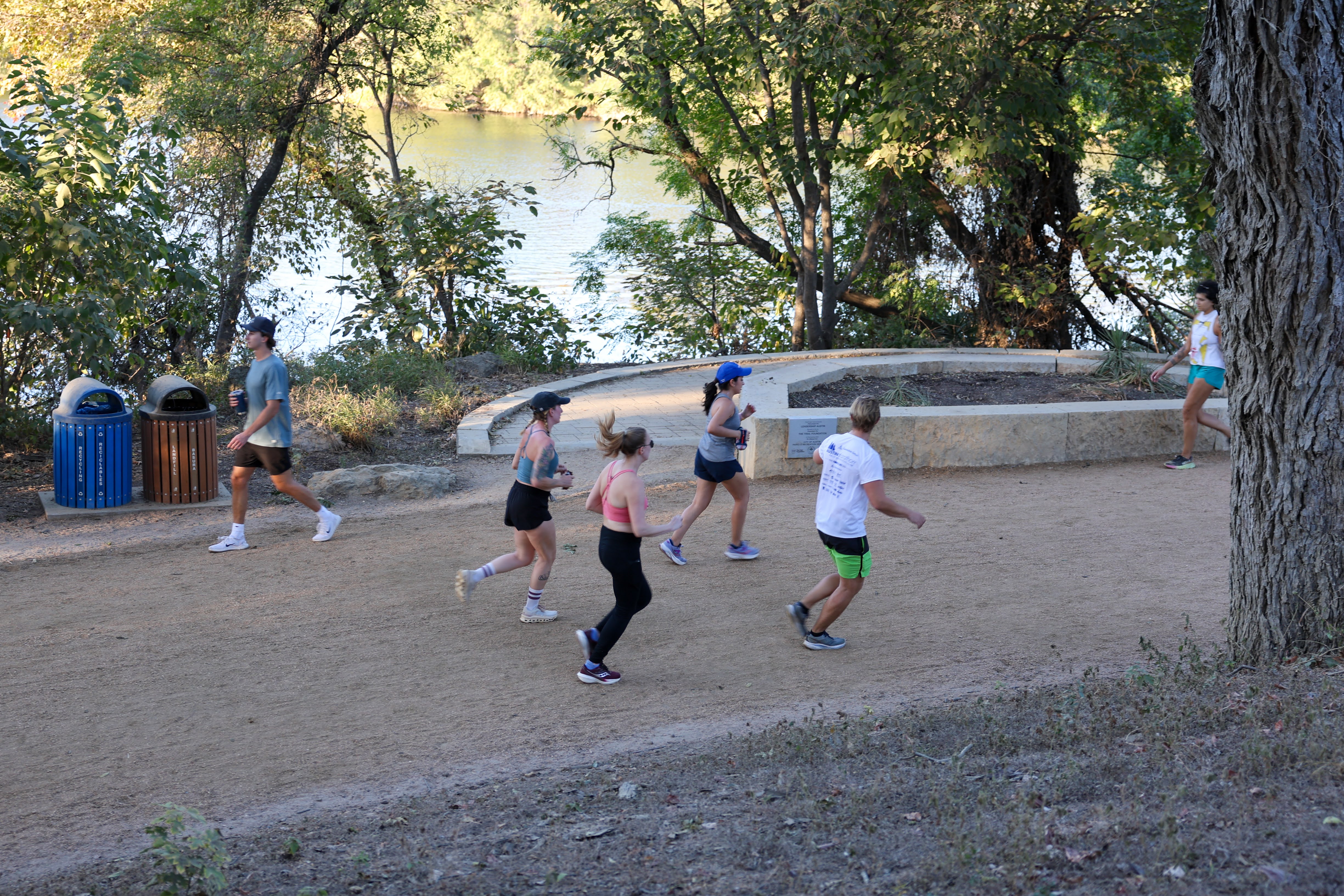
Most people who quit running quit at the same point: somewhere around week 3, when the running intervals get long enough that a too-aggressive plan stops being sustainable. It's not a willpower problem. It's a programming problem.
Most beginner running programs are designed for 25-year-olds. None to Run is different — built for people in their 40s, 50s, and 60s, many of whom tried Couch to 5K and burned out at exactly that week-3 wall. This guide is the gentler way in.
Before your first run, take a moment to assess where you're starting from. Most people can begin a walk/run program right away without any issues. But if you have a pre-existing injury, joint problems, or haven't been active in a long time, a quick conversation with your doctor is worth the effort. It's easier to get clearance before you start than to have to stop after your first few sessions.
One honest question to ask yourself: when was the last time you walked continuously for 30 minutes?
If the answer is "not recently," spend a week or two building up to that before adding any running. It sounds overly simple, but it's exactly the kind of foundation that prevents the injuries that derail most beginners.
It's also worth getting your gear sorted before day one. You don't need to spend a lot, but a comfortable pair of running shoes and well-fitting clothes make a real difference to how enjoyable those first runs feel. Being physically uncomfortable is a distraction you don't need when you're already adapting to something new.
When it comes to shoes, ignore the old advice about gait analysis, the "wet foot test," or choosing between neutral and stability categories. Research has shown that none of that reliably prevents injury. Instead, try on a few pairs and go with what feels most comfortable. That's it. Comfort is the single best predictor of the right shoe for you.
If you want to go deeper: How to Buy Running Shoes and Finding the Right Running Shoes.
There's also a psychological benefit: research suggests that identifying yourself as a runner early on — even just by wearing running clothes — is associated with sticking with it longer term.
The single biggest factor in becoming a runner isn't your shoes, your app, or your program.
It's showing up regularly.
Set a simple target: get out for 20–30 minutes, two to three times per week. None to Run is built around three sessions a week — enough to build fitness while giving your body adequate recovery time between runs. If three feels like too much in your first week, two is fine to start. What matters most is building the habit, because everything else grows from there.
One useful trick: research shows people are significantly more likely to take up healthy habits at natural fresh-start moments — the new year, after a birthday, the start of a new season. If you're reading this, you've already got some motivation. Use it now, before it fades.
Don't wait until you feel ready. The readiness comes after you start, not before.
And if you can only manage five minutes today, that counts. Research has shown that even five minutes of running provides measurable health benefits. You don't need to hit a minimum before it "counts." Every time you get out the door, something good is happening.
Here's one of the most common early experiences: you head out with good intentions, run for two minutes, and feel completely winded. That's not a sign you're not cut out for running. It's completely normal, and it has a straightforward fix.
Alternating running and walking — the run/walk method — is one of the most effective ways to build a running base. It significantly reduces injury risk by lowering the strain on your muscles, soft tissues, and bones, while still building real cardiovascular fitness.
It's the foundation of every None to Run program.
The right ratio depends on where you're starting from. None to Run starts with just 30 seconds of running followed by 2 minutes of walking — shorter intervals than almost any other beginner program, and deliberately so.
That gentler starting point is one of the biggest reasons people who struggled with Couch to 5K succeed with None to Run. If you have a stronger fitness background, 1 minute running and 2 minutes walking is a reasonable alternative starting point. Either way, find the ratio that lets you finish a session feeling like you could have done a little more.
A simple Week 1 session looks like this:
Each week, the running intervals get a little longer and the walking breaks get a little shorter. By the end of None to Run's 12-week program, most people are running continuously — something that felt impossible on day one.

Most beginner programs are built around distance — run 1 mile, then 2, then 3. The problem is that distance ignores how your body is actually feeling on a given day. Your pace changes, the terrain changes, the weather changes.
None to Run is built entirely around time-based training. Instead of chasing a distance, you simply run for a set number of minutes. This removes the pressure to perform and keeps the focus on consistency — which is exactly what beginners need.
Worth knowing: Traditional programs like Couch to 5K see dropout rates as high as 64.5%. Time-based, low-pressure programs keep beginners engaged longer and result in fewer early injuries.
When your run is "15 minutes easy," there's no pressure to cover a certain distance. You can slow down, speed up, or take a walk break without feeling like you've failed. For people who've struggled with other programs, that shift in mindset alone can make all the difference.
These two issues are almost always the same problem in disguise.
The most common mistake new runners make is going too fast. Research on beginner runners consistently shows that new runners set off far too quickly — partly because of the belief that running should feel hard, otherwise it doesn't count. That's a myth. Running at a pace where you're breathless and struggling isn't more effective. It just leads to injury, burnout, and the belief that you're simply "not a runner."
A good starting pace is one where you can hold a full conversation without gasping. This is sometimes called conversational pace, and it's where most of your early runs should happen. It will feel almost embarrassingly slow. That's a good sign.
The talk test: If you can say a full sentence out loud without struggling for breath, you're at the right pace. If you're only managing two or three words, slow down — or take a walk break.
Breathing difficulty in early runs is almost always a pacing problem, not a fitness problem. When you run faster than your body can comfortably supply oxygen, your breathing gets laboured. The instinct is to push through it. The right move is to slow down.
A few things that actually help with breathing:
Breathe through your mouth. Nose breathing alone limits your oxygen intake when you're working hard. Mouth breathing — or a mix of both — gets more oxygen to your muscles. Don't overthink it.
Stop trying to control it consciously. Research has found that breathing is a highly automated process that responds most efficiently to exercise when you're not consciously trying to manage it. You don't need to count breaths or follow rhythmic patterns. Take care of your pace, and your body handles the breathing.
Use it as a pacing guide instead. Check in every few minutes: comfortable, or gasping? If you can't speak in full sentences, ease off. This simple loop — tune in, adjust, carry on — is one of the most useful habits you'll build as a new runner.
The good news: breathing while running gets dramatically easier as fitness improves. What feels overwhelming in week one feels manageable by week four. Read our full breathing guide here.
Research also shows that people are far more likely to form a lasting exercise habit when they enjoy it. Running at a pace that feels good isn't taking the easy way out — it's the smart way in.
Don't wait until you're "serious" about running to start strength training. It's arguably more important for beginners than for experienced runners — and it's one of the things that sets None to Run apart from almost every other beginner program.
Running is a linear, repetitive movement — the same muscles, joints, and motion repeating hundreds of times per minute. Your cardiovascular system adapts to this fairly quickly. Your tendons, ligaments, and bones do not.
The supporting muscles around your hips, glutes, and calves are often underdeveloped in people new to running, which is why so many beginners end up with knee pain, shin splints, or Achilles issues in the first few weeks.
Strength training addresses this directly. A strong core improves running efficiency. Strong hips and glutes absorb impact more effectively. Strong calves protect your Achilles. Even your upper body contributes — research shows that better arm swing improves overall stride efficiency.
The American Heart Association has noted that just 15–20 minutes of resistance training improves blood pressure, glucose levels, body composition, sleep quality, and even depression and anxiety. That's a significant return on a small investment.
You don't need a gym. Bodyweight exercises two or three times a week — squats, lunges, glute bridges, calf raises, core work — are enough to make a real difference. None to Run includes short routines designed specifically for new runners on our strength and mobility page. They take 15 minutes and are built to complement your running sessions.
One more note: save your stretching for after your run, not before. Static stretching on cold muscles before a run doesn't help prevent injury — current research actually suggests it can reduce performance. A light walk or dynamic warm-up before you run is all you need. Stretch when you get back, when your muscles are warm.
Running is one of the simplest activities out there, but a few basic safety habits are worth building in from day one:
None of this needs to slow you down. It just becomes automatic after a few runs.
Further reading: Staying Safe When You Run
Your body's adaptation gap is the most important thing most beginners never learn about — and understanding it changes everything.
Running is essentially a series of hops. Each time your foot lands, your muscles, tendons, and ligaments have to absorb and control the impact — a process called eccentric loading. Studies show each leg bears up to three times your body weight with every stride. In a 25-minute run, that's roughly 3,700 leg impacts. That's an enormous cumulative force.
Think of it like dropping a tennis ball from a rooftop.
The ball compresses on impact, then springs back up because it's rubber. Your body has to do the same job — absorb that force — but without the rubber. Your muscles and connective tissues do that work, and they need time to adapt to doing it thousands of times per session.

Here's the critical thing: your cardiovascular system adapts to running relatively quickly. Your heart gets stronger, your breathing improves, runs start feeling easier within a few weeks. But your tendons, ligaments, and bones adapt much more slowly — sometimes taking months. So you'll often feel like you can do more before your connective tissues are ready for it. That gap is where most running injuries happen.
Even when a run feels easy, resist the urge to add significantly more. Your lungs may be ready. Your tendons may not be.
You've probably heard of the 10% rule — never increase weekly mileage by more than 10% at a time. It's a reasonable instinct, but the research doesn't support the specific number. A 2008 University of Groningen study of 532 runners found nearly identical injury rates between those following 10% increases and those increasing by 50% per week. A 2012 Danish study found uninjured runners averaged 22.1% weekly increases — more than double the rule. Systematic reviews have concluded it simply isn't grounded in science.
That said, the spirit of the rule is right — and for beginners especially, erring on the side of caution still makes sense. Not because of a specific percentage, but because your connective tissues genuinely need more time than your cardiovascular system to adapt. The takeaway isn't "I can progress faster" — it's "go by feel, be conservative, and don't let feeling good on a run convince you to do dramatically more."
Progress gradually, spread any increases across multiple sessions, and treat unusual soreness in your knees, shins, or Achilles as a signal to ease back rather than push through.
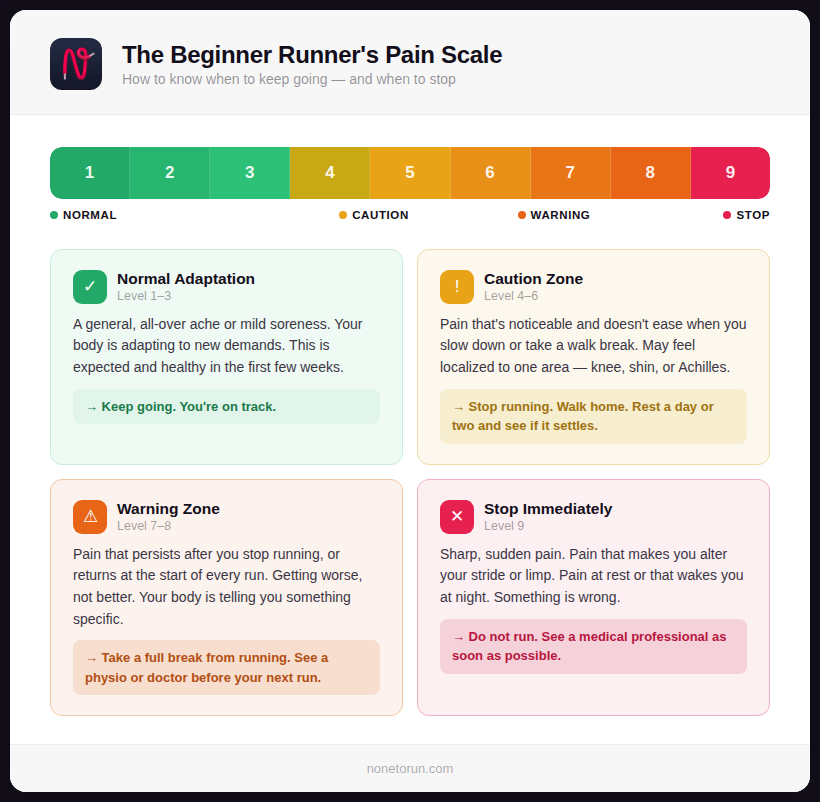
A useful way to think about pain in those early weeks: on a scale of 1 to 10, a general, all-over ache at a 1, 2, or 3 is normal — your body is adapting to new demands. But if pain creeps up to a 4 and stays there, or doesn't go away when you stop running, that's a signal to back off. And if it's sharp, localized, or getting worse rather than better, see a physio or doctor before your next run. Most beginner injuries are minor and fixable — but only if you catch them early instead of pushing through.
More recent research tracking over 5,200 runners also found that the real injury risk comes from sudden spikes in a single run — going much further in one session than your longest run in the past 30 days. Another good reason to keep individual sessions controlled, even when your fitness is improving.
Mixing in lower-impact activity like cycling or walking on non-running days helps your cardiovascular fitness keep building while your connective tissues catch up.
None to Run's progression is designed with this adaptation gap in mind — it's why the program starts slower and builds more gradually than almost anything else out there. And if a week feels too hard, repeating it before moving forward is always the right call.
The physical side of running gets a lot of attention. The mental side matters just as much, especially in the early weeks when running still feels genuinely hard.
Research on beginner runners shows that how you think during a run directly affects how difficult it feels. A few strategies that work:
Running with a friend, in a scenic spot, or with a good playlist all reduce perceived effort. Research shows music makes running feel more enjoyable and less effortful.
Studies also show that pleasant distractions can help runners enter a flow state where running feels genuinely easier. If possible, aim for green environments with low traffic — beginner runners consistently rate these as the most enjoyable places to run, and exercising in nature has been shown to reduce stress beyond the benefits of exercise alone.
One of the biggest mental barriers for new runners is feeling self-conscious — worrying that you look awkward, that you're too slow, or that "real" runners are watching and thinking less of you.
Here's the truth: they're not. Most experienced runners will tell you that seeing a beginner out there is one of the most motivating things they encounter on a run. Everyone started somewhere. Nobody is looking at you and thinking you don't belong. They're thinking the opposite.
Instead of thinking "I have to run for 5 minutes," focus on the next lamp post, then the next corner. This strategy — chunking — makes longer efforts feel much more manageable. Research has shown that mentally chunking a run can make it feel easier even while covering the same distance.
Most beginners hit moments where the internal commentary turns ugly: Why am I doing this? I hate this. This is too hard.
That's completely normal. Developing a short personal mantra — "Strong and steady," "I can do this" — and repeating it when things get hard has been shown in multiple studies to meaningfully improve performance and reduce perceived effort. It sounds simple because it is — and it works.
Before a run, think: if this gets difficult, I will... — slow down, take a walk break, repeat your mantra, focus on the next landmark. This if-then planning means you have a response ready when motivation dips, rather than improvising when you're already struggling.
Every runner has sessions that feel terrible — heavy legs, laboured breathing, no motivation. Research on exercise psychology shows that accepting hard days as part of the journey — rather than as evidence of failure — is one of the strongest predictors of long-term adherence. The goal on a hard day isn't to run fast or far. It's to run again.
One more thing about those difficult sessions: don't judge a run by the first ten minutes. It's surprisingly common — even for experienced runners — to feel heavy, stiff, and unmotivated at the start. More often than not, something shifts after those first few minutes and the run turns into something enjoyable. So if you're five minutes in and hating it, give it a little longer. You might be surprised.
Setting a goal also helps. It doesn't have to be a race — it could be running continuously for 20 minutes, completing a parkrun, or just finishing the program. And if you can find even one person to run with, research consistently shows that social running reduces perceived effort and makes sessions more enjoyable. You show up because someone is waiting, not because you forced yourself.
Read the full article: 5 Mental Strategies to Make Running Feel Easier — written by Dr. Noel Brick, PhD, who has spent over a decade researching what runners think about and how it affects their experience.
At some point you'll wonder if you're running "correctly." Are your arms right? Is your foot landing wrong? Should you be leaning forward more?
For now, don't think about any of that. Seriously — give yourself at least six months before you even start paying attention to form. Your body is remarkably good at self-correcting as it adapts to running. The more you run, the more efficient your movement naturally becomes.
If you're curious, try this: take a short video of yourself running in your first few weeks. Then take another one six months later. You'll be surprised at how much your form has improved without any conscious effort.
The one thing worth paying attention to early on is overstriding — landing with your foot well ahead of your body. If it happens, it usually fixes itself when you slow down.
Further reading: How to Improve Your Running Form
A structured plan removes the guesswork entirely — no deciding how long to run, how hard to push, or when to rest. It's all done for you.
None to Run offers several free programs depending on where you're starting from:
All plans are built around time-based sessions, run/walk intervals, gradual progression, and built-in rest. The app is available on iOS and Android and includes audio coaching, progress tracking, and a community of over 12,000 people at the same stage of their running journey.
Starting running doesn't require speed, athleticism, or a perfect history with fitness. It requires patience, consistency, and a program that meets you where you are.
Run/walk your way through the early sessions. Keep the pace conversational. Sort out your breathing by slowing down, not pushing harder. Add a little strength work. Build gradually and go by feel. Use your mind as a tool. Don't let a hard day become a reason to stop.
And when you hit a milestone — your first full week, your first continuous run, your first 5K — celebrate it. You earned it. Treat yourself to a new piece of running gear, go out for a meal, sign up for a local race. These moments matter, and marking them helps cement the identity you're building.
Because here's the thing: if you run, you're a runner. Not when you hit a certain pace. Not when you finish a race. Not when you "look like" a runner. Right now. Today.
You don't have to be fast. You just have to start.
Most beginners can work up to running continuously for 20–25 minutes within 10–14 weeks, following a gradual walk/run program. None to Run's 12-week beginner plan is specifically designed to get you there safely.
Absolutely. The run/walk method is one of the most effective ways to build running fitness as a beginner. Walking breaks are part of the plan, not a sign of failure.
Almost always a pacing issue, not a fitness issue. You're running faster than your body can comfortably supply oxygen. Slow down until you can speak in full sentences — that's your target effort level.
Two to three times per week is ideal for most beginners. This gives your body enough stimulus to adapt while allowing adequate recovery time between sessions.
For many people, yes. Research shows it has a dropout rate of up to 64.5%. None to Run was specifically designed as a gentler alternative, starting with 30-second run intervals and a slower 12-week progression.
It's not mandatory, but it makes a significant difference — especially for reducing injury risk. Even two short bodyweight sessions per week can help your muscles and connective tissues adapt to the demands of running.
You don’t need to be fast, fit, or fearless to become a runner.You just need a simple plan, an encouraging community, and the consistency to keep showing up — and None to Run gives you all three.

6,700 + Ratings in the Apple App Store

Time is hard to come by. Kids, work, and other commitments can get in the way. You need a plan that's easy to follow and can work around you, not the other way around.

You look "weird" when you run. You’re “not” a runner. You’re too “slow” or too "Old." We're here to tell you right here, right now, that you’re wrong. You only *think* these things because it's new and you feel uncomfortable. That'll change with consistency and time. You are a runner!

It may have been hard previously, but it doesn't have to be – now, you'll be given the tools and the knowledge to succeed. We’re doing things differently in order to see different results.

Running when you aren't ready or without the proper training can hurt, leaving you with nagging injuries that never seem to clear up. We ease you in, giving you the strength and conditioning you need to make sure your running doesn't come with pain.