


4.8 out of 5 Stars
6,700 + Ratings in the Apple App Store

Get our free printable running plan, specifically tailored for beginners
Access exclusive strength & mobility training videos
Overcome common injuries with our expert tips
Join our 12,000+ strong running community
If couch to 5k is too hard - this is the plan for you! This has got me running after injuries and surgeries and starting all over building fitness! Great program and lots of support!

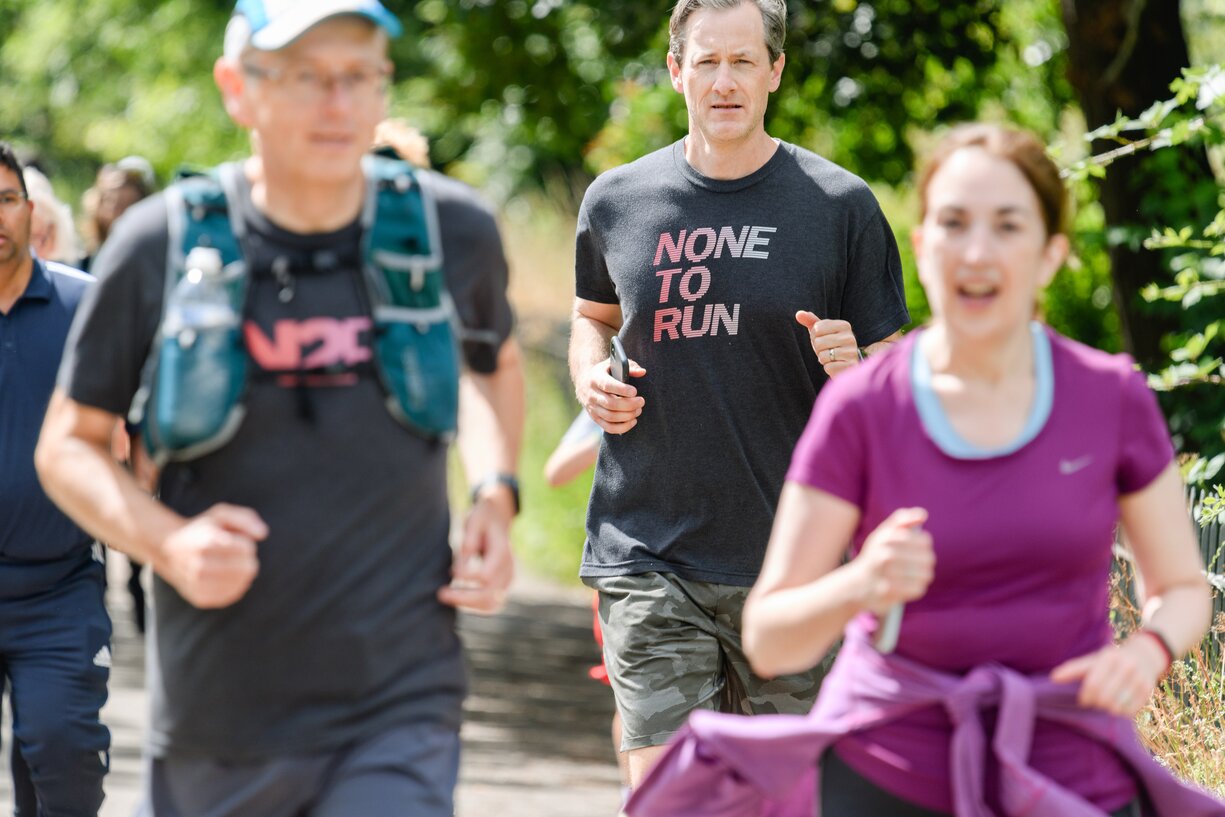
This isn’t news to anyone: Our bodies are not the same at age 50 as they were at age 20…or 30, or 40. But that doesn’t necessarily mean that we’re worse off, as athletes of any kind, in our fifties and beyond. We’re smarter in our 50s than we were in our 20s.
We have a breadth of knowledge to pull from; we know ourselves better than we did in our youth. We can take that knowledge as power to approach our health and fitness as experts of our own bodies.
It's true that we naturally lose muscle mass and bone density as we age, and our joints may become stiff. But being an older runner doesn’t necessarily mean that we need to do less—fewer miles, less intense training, fewer goals, less time on our feet. In fact, being a new or returning over age 50 means that we need to (get to!) do more.
Because of the natural loss of muscle mass, called sarcopenia, and the loss of bone density, we need to strength train. Experts recommend lifting weights two to three times a week, for 20-30 minutes per session, with a couple of days of rest in between lifting sessions.
Body weight exercises like air squats, lunges, pushups, and sit-ups are a good place to start, but the goal is to advance to stressing your muscles, bones, and joints with weights. As always, it’s important to use good form when lifting weights (but you knew this already because you’re 50 and not 20).
Maintaining and constantly building strength can help us stay healthy and feel good while we’re on our running journeys and in general.
None to Run App
The None to Run app was designed specifically for beginners — with a gradual, sustainable plan that works for real people starting from scratch.
Athletes of any age need ample amounts of protein, but as we age, we need more. Starting around age 30, our bodies start experiencing anabolic resistance. Basically, it becomes harder to absorb protein and build muscle. While the exact amount of protein needed varies by individual, studies point to 1.2-1.6 grams of protein/kg of body weight needed for older athletes.
Proprioceptive awareness—our body’s sense of where it is in space—generally decreases with age. Our senses begin to change, which can affect our balance.The good news is that running can improve proprioception, especially if you’re running on varied surfaces. I’m a huge proponent of trail running for a variety of reasons—nature therapy, strength training, variety, fun—and building balance is another benefit to hitting the dirt.
We may not recover from harder efforts as quickly as we did in our youth, but that just means we need to be smarter. We’d be wise to focus on quality over quantity, and make sure we’re giving ourselves enough rest in between efforts. It’s also important to prioritize sleep, refueling, and rehydrating. This is where listening to the body we’ve had for so long comes in particularly handy. If body part or your whole system is nudging or nagging you to get more rest, then you’d be wise to get more rest before jumping into another workout.
More variety. While younger athletes may be able to run every day of the week, they’re missing out on the fun that is doing a variety of activities. Older athletes benefit from mixing things up. Call it cross-training or call it enjoying a bunch of different things, but alternating running days with other activities like cycling, swimming, Nordic skiing, surfing, weight training, skiing, etc. is good for both an aging body and mind.
You don’t need to be fast, fit, or fearless to become a runner.You just need a simple plan, an encouraging community, and the consistency to keep showing up — and None to Run gives you all three.

6,700 + Ratings in the Apple App Store

Time is hard to come by. Kids, work, and other commitments can get in the way. You need a plan that's easy to follow and can work around you, not the other way around.

You look "weird" when you run. You’re “not” a runner. You’re too “slow” or too "Old." We're here to tell you right here, right now, that you’re wrong. You only *think* these things because it's new and you feel uncomfortable. That'll change with consistency and time. You are a runner!

It may have been hard previously, but it doesn't have to be – now, you'll be given the tools and the knowledge to succeed. We’re doing things differently in order to see different results.

Running when you aren't ready or without the proper training can hurt, leaving you with nagging injuries that never seem to clear up. We ease you in, giving you the strength and conditioning you need to make sure your running doesn't come with pain.