


4.8 out of 5 Stars
7,100+ Ratings in the Apple App Store

Get our free printable running plan, specifically tailored for beginners
Access exclusive strength & mobility training videos
Overcome common injuries with our expert tips
Join our 12,000+ strong running community
If couch to 5k is too hard - this is the plan for you! This has got me running after injuries and surgeries and starting all over building fitness! Great program and lots of support!


You've made it through the first four weeks of Couch to 5K. You're feeling pretty good. Maybe a little tired, but you're gaining confidence with each run.
Then Week 5 hits.
Suddenly, the program asks you to run for 20 minutes straight—no walking breaks. That's more than double your longest run from just days ago.
Your legs feel heavy. Your breathing becomes labored. That voice in your head starts whispering, "I can't do this. I'm not ready."
If this sounds familiar, you're not alone. Week 5 is where Couch to 5K breaks most people. Research shows that nearly three-quarters of dropouts quit before reaching the halfway point of the program, and Week 5 is often the tipping point.
As an RRCA-certified running coach who's guided over 100,000 beginner runners, I've seen this pattern countless times. Here's the truth: Week 5 isn't hard because you're not cut out to be a runner. It's hard because the program asks too much, too soon.
Let me explain why Week 5 feels impossible—and what you can actually do about it.
Let's look at what Couch to 5K actually asks you to do in Week 5:
Week 4, Day 3: Run for 5 minutes (your longest continuous run yet)
Week 5, Day 1: Run for 5 minutes twice with a 3-minute walk break
Week 5, Day 2: Run for 8 minutes twice with a 5-minute walk break
Week 5, Day 3: Run for 20 minutes straight with no walking breaks
That final workout of Week 5 is a massive leap. You go from running 8 minutes as your longest stretch to suddenly running 20 minutes continuously—a 150% increase in just three days.
In running terminology, this is an aggressive progression that violates nearly every principle of safe training adaptation. Even experienced runners would find this jump challenging.
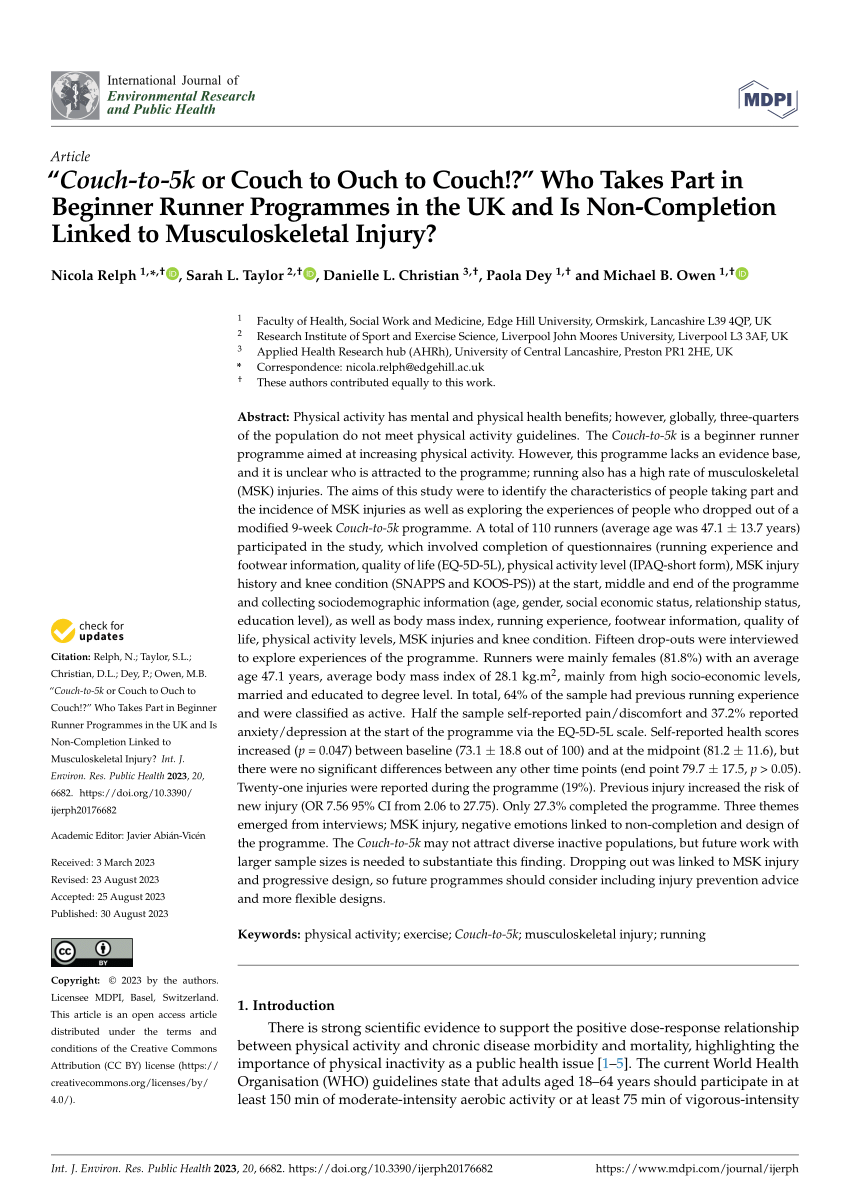
A comprehensive study examining Couch to 5K found that participants consistently described the program's leap in running time during Week 5 as overwhelming. Researchers noted that dropouts linked this aggressive progression directly to injuries and discouragement.
The study revealed that people perceived Week 5 as the moment when running stopped feeling achievable and started feeling impossible. When something feels impossible, our brains quite reasonably tell us to stop—it's a protective mechanism.
Understanding why Week 5 feels so hard requires knowing what's actually happening inside your body when you run.
Every time your foot strikes the ground while running, your body must absorb approximately three times your body weight in impact force. During a typical 25-minute run, each leg experiences roughly 3,700 individual impacts.
Your cardiovascular system—your heart, lungs, and blood vessels—adapts to exercise relatively quickly. Within a few weeks, you'll notice your breathing improves and your heart doesn't pound quite as hard.
But your connective tissues—tendons, ligaments, and the structural components of your muscles—adapt much more slowly. These tissues need weeks to strengthen and become resilient enough to handle running's repetitive stress.
This creates a dangerous mismatch: by Week 5, your cardiovascular system might feel ready to run 20 minutes, but your connective tissues definitely aren't. Your body needs gradual progression to safely build the structural support required for longer runs.
When your foot lands during running, your muscles must work while lengthening to control the impact—a process called eccentric loading. This controlled absorption of force causes significant muscle soreness and, when increased too quickly, can lead to common running injuries like shin splints and IT band syndrome.
Week 5's sudden jump from 8 to 20 minutes dramatically increases the total eccentric loading on your body before your muscles have adapted. It's like asking someone who's been lifting 10-pound weights to suddenly bench press 25 pounds—the jump is simply too big too fast.
Week 5 isn't just physically challenging—it's psychologically overwhelming.
When you look at a 20-minute continuous run on your schedule after barely completing 8-minute intervals, your brain immediately starts creating doubt. Research on endurance psychology shows that our perception of difficulty strongly influences our actual performance. When we believe something will be impossibly hard, it becomes harder.
During Week 5, many runners experience what researchers call negative self-talk—that internal voice saying things like:
One beginner runner I interviewed described their Week 5 experience: "I couldn't get my breathing right. My total attention was on trying to breathe. And it took me weeks to regulate it! It was just being focused on breathing and thinking, 'Why am I doing this? I hate this! Why am I putting myself through it?'"
This mental spiral is completely normal—but it makes Week 5 even harder than it needs to be.
When facing a 20-minute run for the first time, your brain sees it as one enormous, overwhelming task. Mental strategies like chunking—breaking a long run into smaller, manageable segments—can help, but Week 5 doesn't give you time to develop these skills gradually.
You're thrown into the deep end before learning to swim in shallow water.
Smart running progression follows what's often called the 10% rule: don't increase your weekly running volume by more than 10% at a time. While beginners can sometimes progress faster than this guideline, Week 5 of Couch to 5K doesn't just break the rule—it shatters it.
From Week 4 to Week 5, you're increasing your longest continuous run by 150%. From Week 5 Day 2 to Week 5 Day 3, you're increasing it by 150% again within the same week.
None to Run's progression chart compared to Couch to 5K shows this visually—C25K's line shoots up dramatically at Week 5, while N2R maintains a steady, sustainable climb.
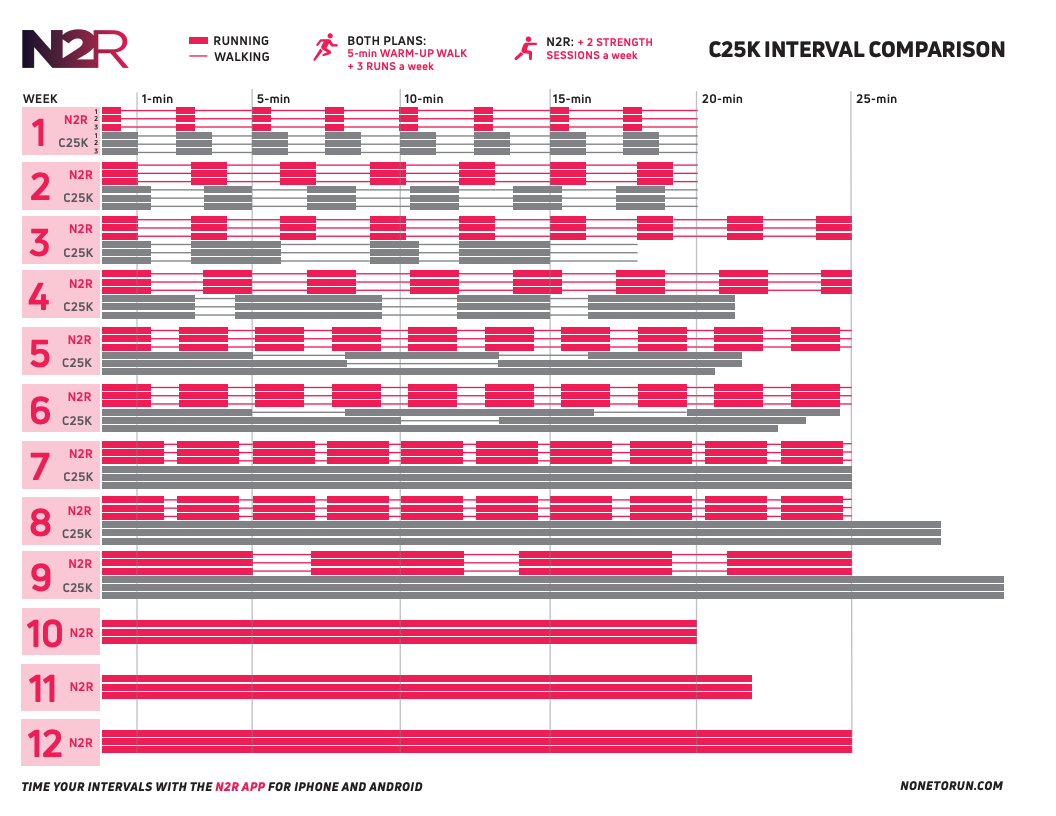
Even athletes would find this aggressive. For true beginners, it's a setup for failure.
.avif)
If you're stuck at Week 5—or dreading its approach—here are your realistic options:
There's absolutely no shame in repeating a week. In fact, giving your body more time at the Week 4 level is the smart choice.
Repeat Week 4 for one or two additional weeks before attempting Week 5. This gives your connective tissues crucial adaptation time while your confidence continues building.
Many runners who repeat weeks end up having more sustainable, injury-free running careers than those who push through too quickly.
Instead of attempting the full 20-minute run, create a modified version:
After successfully completing your modified version once or twice, then attempt the full 20 minutes.
If Week 5 feels impossible and you're losing motivation, consider that Couch to 5K might simply not be the right program for where you are right now.
None to Run offers a gentler alternative specifically designed for true beginners. Instead of jumping from 8 to 20 minutes, N2R builds you up gradually over 12 weeks with much smaller increases. The program also includes strength training to prepare your body for running's demands—something C25K completely lacks.
By Week 10 of None to Run, you're running 20 minutes continuously—but you've had weeks of gradual build-up to get there, not days.
Not sure how the options compare? See how the top beginner running apps stack up side by side — including how None to Run's progression differs from every major alternative.
If you're determined to push through Week 5 as written, employ these psychological tools:
Break it into chunks: Don't think about running 20 minutes. Focus only on the next 5 minutes, then the next 5, and so on. Chunking makes longer runs feel more manageable by creating multiple "finish lines."
Develop positive self-talk: Instead of "I can't do this," try "This is challenging right now, but I'm getting stronger." Research shows that acknowledging difficulty while adding encouragement helps runners push through tough moments.
Practice distraction: Run somewhere scenic, listen to music, or run with a friend who can talk you through the hard parts. Pleasant distractions reduce perceived effort.
Plan your response: Before the run, decide what you'll tell yourself when it gets hard. Something like "Strong and steady" repeated rhythmically with your steps can anchor you.
Here's something important: knowing when to stop isn't the same as quitting. Smart runners listen to their bodies.
Stop your run if you experience:
These are signs your body needs more time. Walking the rest of your workout and trying again in a few days is the wise choice, not a failure.
Curious what Week 5 looks like in a program designed for sustainable progression?
None to Run's Week 5 continues with 90-second run intervals followed by 1-minute walk breaks, repeated 10 times. You're building consistency and confidence without dramatic jumps.
The program doesn't ask you to run continuously for extended periods until Week 10—and by that point, your body has had adequate time to adapt.
This is how beginner running programs should work: gradual increases that respect your body's adaptation timeline while keeping you motivated and injury-free.
If Week 5 of Couch to 5K feels impossible, please understand this: the problem isn't you.
The program's design simply doesn't account for how most true beginners' bodies adapt to running. The research is clear—nearly two-thirds of people don't finish Couch to 5K, with Week 5's aggressive jump being a major reason why.
You deserve a program that meets you where you are and builds you up safely. Whether that means repeating weeks of C25K, modifying the workouts, or switching to a different plan entirely, you're making the smart choice by listening to your body.
Running should challenge you, but it shouldn't break you. There's a better way forward—one that respects both your potential and your limitations.
If Week 5 has you questioning whether running is for you, consider this: over 100,000 people who struggled with or quit Couch to 5K have successfully become runners using None to Run's gentler approach.
None to Run offers:
✅ Gradual 12-week progression that builds sustainably
✅ Time-based intervals (no pressure about distance)
✅ Built-in strength and mobility training to prevent injury
✅ Repeatable weeks designed into the plan
✅ A supportive community of people who "get it"
Download the None to Run app free or get the full training plan PDF to see how a beginner program should actually work.
Take our 45-second quiz to find out whether Couch to 5K or None to Run is a better fit for your current fitness level.
Is it normal to fail Week 5 of Couch to 5K?
Absolutely. Week 5's jump from 8 to 20 minutes is too aggressive for most true beginners. Research shows the majority of people struggle at this stage. It's not a personal failure—it's a flaw in the program's design.
Should I repeat Week 5 if I can't finish it?
Yes, but I'd actually recommend repeating Week 4 instead. Give your body more time at that level before attempting the Week 5 jump. There's no timeline you must follow—what matters is building sustainably.
How can I mentally prepare for the 20-minute run?
Focus on breaking it into smaller chunks—four 5-minute segments instead of one 20-minute run. Develop a positive self-talk phrase to repeat when it gets hard. Run somewhere pleasant or with someone encouraging. And remember: if today isn't the day, that's okay.
What if I can only run 10 or 15 minutes, not 20?
That's still incredible progress! Run what you can, walk briefly, then finish the time running. Gradually extend the running portion over multiple attempts. You're not behind—you're exactly where you need to be.
Is None to Run really easier than Couch to 5K?
None to Run isn't "easier" in the sense of being less challenging—it's smarter. It challenges you appropriately for your current level without overwhelming jumps. Read the full comparison to see how the progressions differ.
Can I go back to Week 4 without losing progress?
Absolutely not! Repeating a week doesn't erase your progress—it consolidates it. You're building a stronger foundation that will serve you for years of running. That's the opposite of losing progress.
If you have any questions about dealing with Week 5 struggles or want to learn more about None to Run's approach, please email me at mark@nonetorun.com.
You don’t need to be fast, fit, or fearless to become a runner.You just need a simple plan, an encouraging community, and the consistency to keep showing up — and None to Run gives you all three.

7,100+ Ratings in the Apple App Store

Time is hard to come by. Kids, work, and other commitments can get in the way. You need a plan that's easy to follow and can work around you, not the other way around.

You look "weird" when you run. You’re “not” a runner. You’re too “slow” or too "Old." We're here to tell you right here, right now, that you’re wrong. You only *think* these things because it's new and you feel uncomfortable. That'll change with consistency and time. You are a runner!

It may have been hard previously, but it doesn't have to be – now, you'll be given the tools and the knowledge to succeed. We’re doing things differently in order to see different results.

Running when you aren't ready or without the proper training can hurt, leaving you with nagging injuries that never seem to clear up. We ease you in, giving you the strength and conditioning you need to make sure your running doesn't come with pain.